
Why The Grid Needs Storage, Not Just Solar
The rapid growth of solar energy has become one of the most visible signs of the global energy transition. Across residential rooftops, commercial facilities, and utility-scale projects, solar installations are expanding as organizations pursue cleaner and more sustainable power sources.
Solar plays an essential role in reducing emissions and diversifying energy generation. But renewable generation alone cannot solve the grid challenges of the future.
A reliable energy system requires more than generation. It requires storage.
At Torus Power Services, we work with utilities, developers, EPC contractors, and infrastructure operators building the next generation of power infrastructure. One trend is becoming increasingly clear across the industry. The future grid will depend on intelligent battery energy storage systems working alongside renewable generation.
To build resilient electrical infrastructure, the conversation must shift from simply adding solar capacity to building integrated systems that combine solar generation with advanced storage solutions.
The Limits of Solar Alone
Solar energy is clean, renewable, and increasingly cost-effective. However, solar production depends entirely on sunlight, which makes it inherently variable.
Electricity generation rises and falls based on weather conditions, seasonal patterns, and the time of day. This variability creates several operational challenges for utilities and grid operators.
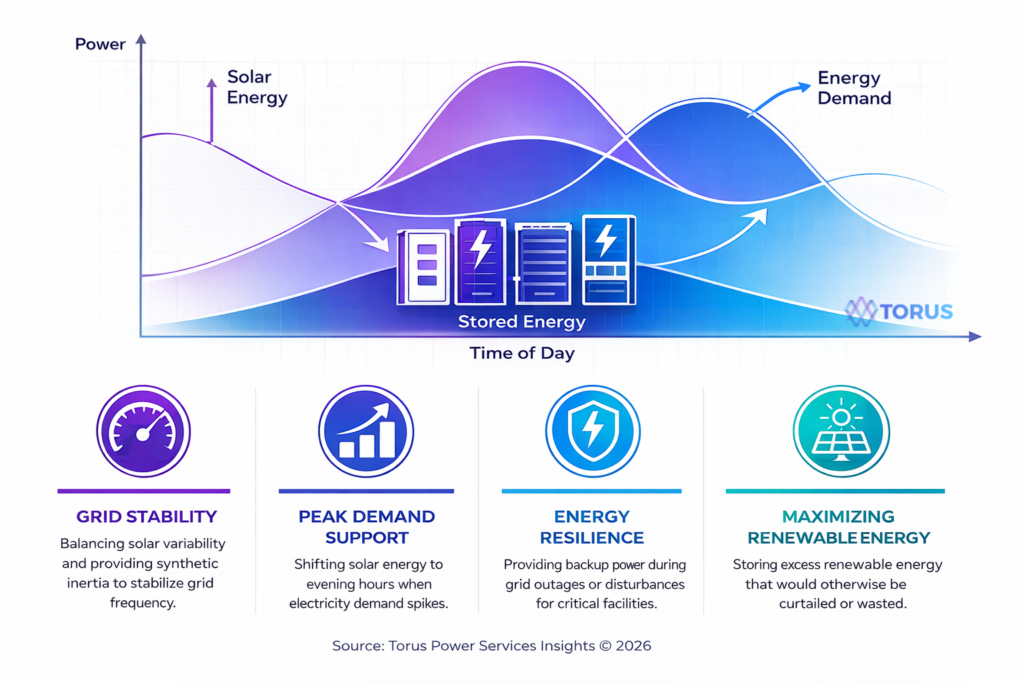
Solar output often peaks during the middle of the day when electricity demand may be lower. At the same time, energy demand typically rises in the late afternoon and evening hours when solar production begins to decline.
But variability is only part of the challenge. The deeper issue is what solar generation does and does not contribute to the fundamental physics of the grid.
System Inertia
Traditional power plants use large spinning generators such as turbines driven by steam, water, or combustion that store kinetic energy as they rotate. This rotational mass provides system inertia, a physical property that resists sudden changes in grid frequency. When generation and load fall out of balance, inertia provides time for operators and automatic controls to respond before frequency deviates to dangerous levels.
Solar photovoltaic generation produces no rotational inertia. As solar displaces conventional synchronous generators, total system inertia declines. Grids with lower inertia are more sensitive to disturbances. Frequency can shift faster and farther following a sudden loss of generation or a large load event. This compresses the window for corrective action and raises the risk of cascading failures.
Diminishing Short Circuit Ratios
Related to inertia is the concept of short circuit ratio, a measure of grid strength at the point where a generating asset connects to the network. A higher short circuit ratio indicates a stronger, more robust connection. A lower ratio signals a weaker point that is more vulnerable to voltage instability.
As inverter-based resources like solar PV displace synchronous generators, short circuit ratios at many interconnection points are declining. Inverters do not inherently contribute fault current the way rotating machines do, which weakens the grid’s ability to maintain stable voltage and respond to faults. This is an increasingly significant concern for interconnection studies and system planning, particularly in regions with high renewable penetration.
Without the ability to store excess power, energy produced during peak solar hours is often curtailed or underutilized. At the same time, the underlying grid becomes progressively less stable as the share of inverter-based generation grows.
This is where energy storage integration becomes essential to the modern grid.
Why Energy Storage Matters
Battery energy storage systems allow electricity to be captured when it is available and deployed when it is needed most. When paired with solar generation, storage transforms intermittent power into a flexible and controllable energy resource.
For grid operators and energy developers, storage unlocks several critical advantages.
Grid Stability and Synthetic Inertia
Storage systems help balance fluctuations in solar generation. By absorbing excess electricity and delivering power when production declines, energy storage supports voltage and frequency stability across the grid.
Advanced battery systems can also provide synthetic inertia by using fast-responding inverter controls to mimic the stabilizing effect of rotating mass. While not identical to physical inertia, these capabilities help compensate for the inertia lost as conventional generation retires.
Similarly, grid-forming inverter technology enables storage assets to actively support voltage and contribute to short circuit strength at interconnection points, directly addressing the weakening short circuit ratios associated with high solar penetration.
Proper power system commissioning and system integration ensure these storage assets operate reliably and safely.
Peak Demand Support
Electricity demand frequently spikes during late afternoon and evening hours. Storage allows utilities and facilities to shift solar energy generated earlier in the day to these high-demand periods, reducing strain on the grid.
Energy Resilience
Battery storage paired with on-site solar can provide backup power during outages or grid disturbances. This capability is particularly important for mission-critical environments such as data centers, where continuous operations are essential.
Maximizing Renewable Energy
In many regions, renewable generation is occasionally curtailed because the grid cannot absorb excess supply. Storage captures this otherwise wasted energy and increases the overall value of renewable energy investments.
The Rise of Integrated Energy Systems
Modern energy strategies are moving beyond standalone generation projects toward integrated systems that combine solar, storage, and advanced control platforms.
These hybrid solutions allow organizations to manage electricity more strategically while improving reliability and operational flexibility.
Integrated energy systems can help organizations:
-
- Reduce electricity costs through demand management
-
- Improve power reliability and resilience
-
- Optimize renewable energy usage
-
- Reduce exposure to grid volatility
Solar generation produces power. Solar paired with battery energy storage systems creates a controllable and dispatchable energy resource, one that can actively support the grid services that inverter-based generation alone cannot provide.
Power Infrastructure Is Evolving
Energy infrastructure is undergoing one of the most significant transformations in decades. As renewable energy adoption grows and electricity demand continues to rise, the next generation of power systems must become more flexible and resilient.
The decline of system inertia and short circuit ratios are not abstract engineering concerns. They are measurable changes already shaping interconnection requirements, grid planning standards, and the operational demands placed on every asset connected to the network. Technologies such as battery energy storage, advanced grid diagnostics, and intelligent operations and maintenance services will play a central role in addressing these challenges.
At Torus Power Services, our teams support developers, utilities, and infrastructure operators who are building these next-generation power systems. Through specialized electrical construction, power system commissioning, and advanced energy infrastructure services, we help ensure solar and storage projects operate safely, efficiently, and reliably.
Building a More Resilient Energy Strategy
Solar energy is an important part of the future grid, but it is only one part of the solution.
To deliver reliable and resilient electricity, renewable generation must be supported by flexible technologies that allow energy to be stored, managed, and delivered exactly when it is needed and that actively contribute to the grid stability services that solar alone cannot provide.
That is where energy storage changes the equation.
Organizations investing in solar paired with storage are building energy systems that are more reliable, more efficient, and better prepared for the evolving demands of the modern grid.
If your organization is exploring battery energy storage integration, power system commissioning, or long-term energy infrastructure support, the team at Torus Power Services can help.
Learn more about how we support modern power infrastructure at Torus Power Services.