

Battery energy storage is becoming an essential part of modern power infrastructure. Utilities, commercial facilities, and industrial organizations are using battery systems to improve resilience, lower energy costs, support renewable generation, and provide grid services¹².
But installing a battery is not the same as building a smart battery project. A successful project starts with clear objectives, intelligent controls, safe system design, and a plan for long-term performance³⁴.
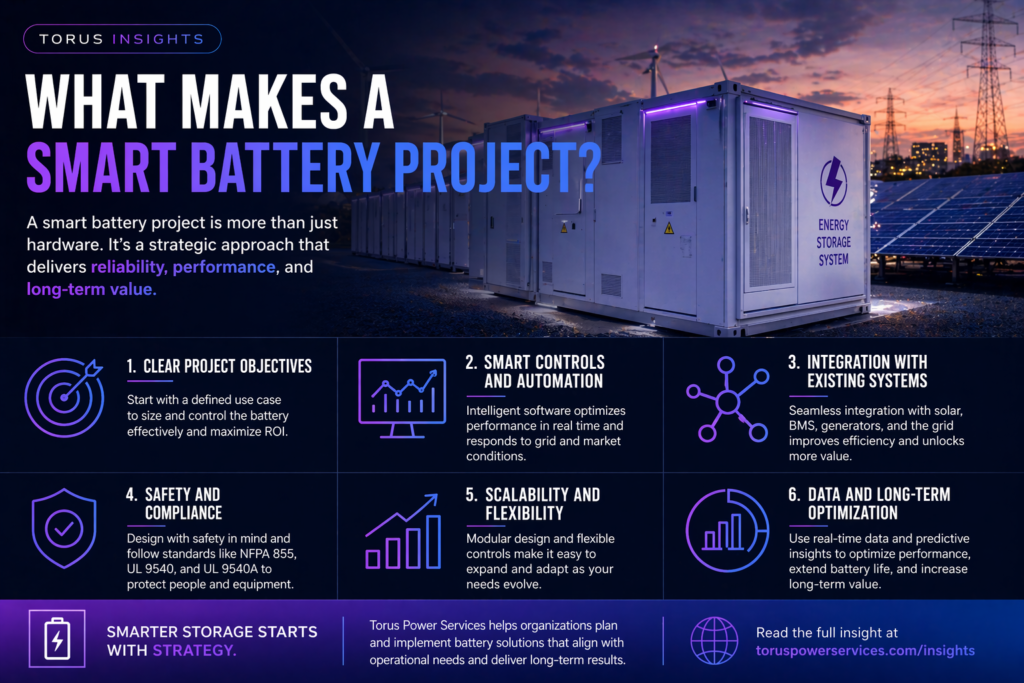
Clear Project Objectives
Every battery project should begin with a defined purpose. Common use cases include peak shaving, backup power, renewable firming, load shifting, frequency support, and grid participation¹³.
When the use case is clearly defined, the battery can be sized and controlled more effectively. That helps improve performance, reduce wasted capacity, and strengthen the return on investment³⁵.
Smart Controls and Automation
A smart battery project depends heavily on the software that manages it. An energy management system can forecast demand, optimize charging and discharging, and react to utility prices or grid events in real time⁴⁶.
This kind of automation helps the battery operate at the right time for the right purpose. It also supports more consistent performance across changing operating conditions and allows the system to respond to both operational and financial priorities⁴².
Integration With Existing Systems
Battery storage performs best when it works as part of a larger energy strategy. It should integrate with solar PV, building energy management systems, backup generators, microgrids, and utility interconnection equipment²⁵.
Strong integration improves overall efficiency and makes the system easier to operate. In renewable-heavy sites, storage can also reduce curtailment and help capture more value from on-site generation⁵¹.
Safety and Compliance
Battery storage projects must be designed with safety in mind. Current safety expectations increasingly emphasize fire-risk evaluation, hazard mitigation, and installation practices aligned with standards such as NFPA 855, UL 9540, and UL 9540A⁶⁷².
The battery management system and thermal controls also play a major role in protecting equipment and personnel. These systems monitor temperature, voltage, and current to help prevent unsafe operating conditions and support reliable long-term operation⁴².
Scalability and Flexibility
Energy needs change over time, so a smart project should be built with future growth in mind. Modular hardware and flexible control systems make it easier to expand capacity or adapt to changing load profiles without redesigning the full system³⁸.
Planning for scalability protects the long-term value of the investment and can reduce future disruption as the facility grows or operating needs evolve⁸⁵.
Data and Long-Term Optimization
A smart battery project does not stop at commissioning. Real-time monitoring and operational data can be used to refine dispatch, predict maintenance needs, and improve battery performance over time⁹¹⁰⁴.
This turns battery storage into an actively managed energy asset rather than a passive backup system. Over time, that approach can increase reliability, extend battery life, and improve total project value⁹¹⁰.
Smarter Storage Starts With Strategy
Battery storage delivers the most value when the project is designed around a clear business case and a strong operating plan. That combination helps organizations improve resilience, control costs, and support broader energy goals¹².
Torus Power Services helps organizations plan and implement battery solutions that align with operational needs, integrate with existing infrastructure, and support long-term performance.
Sources
NREL, Grid-Scale Battery Storage: Frequently Asked Questions
UL, Your Guide to Battery Energy Storage Regulatory Compliance
IEEE PCIC Conference Paper, Specifying Battery Storage Solutions for Industrial Facilities
ScienceDirect, Smart optimization in battery energy storage systems: An overview
Enverus, Battery Storage Siting for Developers: A Guide for Enhancing Energy Management
Exponent, Expanded Safety Guidelines for Battery Energy Storage Systems
CSE Magazine, Understand the codes, standards for battery energy storage systems
Neural Concept, A Guide to Battery Energy Storage System Design
JKESS, Exploring Real-Time Monitoring Benefits in Battery Storage Software
Arshon, Optimizing Energy Storage Systems with Predictive Maintenance